Keywords
Conflict • Hollow Victory • Aftermath
Archetype
The Pyrrhic Winner – The part of you that won something or ended something, and is standing in the quiet afterwards wondering what it actually cost.
Card Meaning
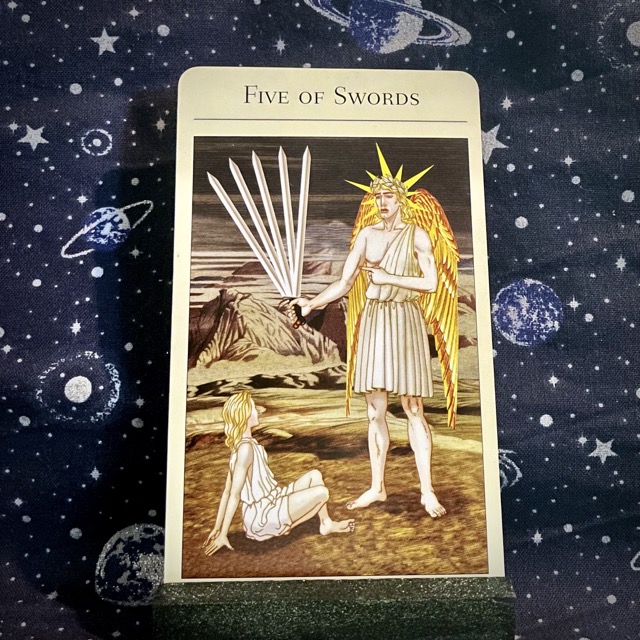
The Five of Swords is the card of the conflict’s aftermath, the hollow, slightly unsatisfying feeling that follows a struggle that ended without genuinely resolving.
It points to situations where what was won came at a cost, where walking away left things unfinished, or where the honest accounting of what happened hasn’t been done yet.
The card tends to surface the question underneath the conflict: not who was right or wrong, but what the situation was actually about, and whether that underlying thing has been addressed or just the surface incident.
The more useful question isn’t what happened, it’s what it revealed.
Connection to Previous Cards
The Nine of Wands arrived yesterday carrying the battered, wary resilience of someone who has been through something and is still standing. The Moon before it showed partial visibility and the honest acknowledgement that not everything is clear yet. After two Tower days disrupted something real, the Five of Swords landing now makes particular sense. The Tower collapsed something. The conflict or difficulty that accompanied that collapse, whatever happened relationally or situationally, is still in its aftermath phase. The Nine of Wands said I’m still standing. The Five of Swords is saying: what exactly happened in that conflict, and has it actually been honestly assessed? The full accounting isn’t complete yet.
Shadow
The Five of Swords has two distinct shadows and they point in opposite directions. The first is the compulsive winner, the person who keeps engaging in conflict to accumulate victories, not because the victories solve anything, but because being right has become a primary way of feeling secure.
This shadow produces relationships and situations that are perpetually combative, where every interaction carries the potential to become a fight because the underlying need isn’t being addressed directly.
The second shadow is the compulsive peace-maker, the person who avoids all conflict so assiduously that things that genuinely need to be addressed never get addressed, and the unspoken tensions accumulate until they produce the very explosion that was being avoided.
Both shadows are avoiding the same thing: the direct, clear engagement with what the conflict is actually about.
Guiding Incantation
The fight is over. The field isn’t clean.
I look at what happened, I look at what it means.
Not to reopen. Not to relitigate the score.
But to understand what it was actually for.
Find more daily tarot reflections at Old Town Witch, including the cards that ask the uncomfortable questions about what conflict is actually about.